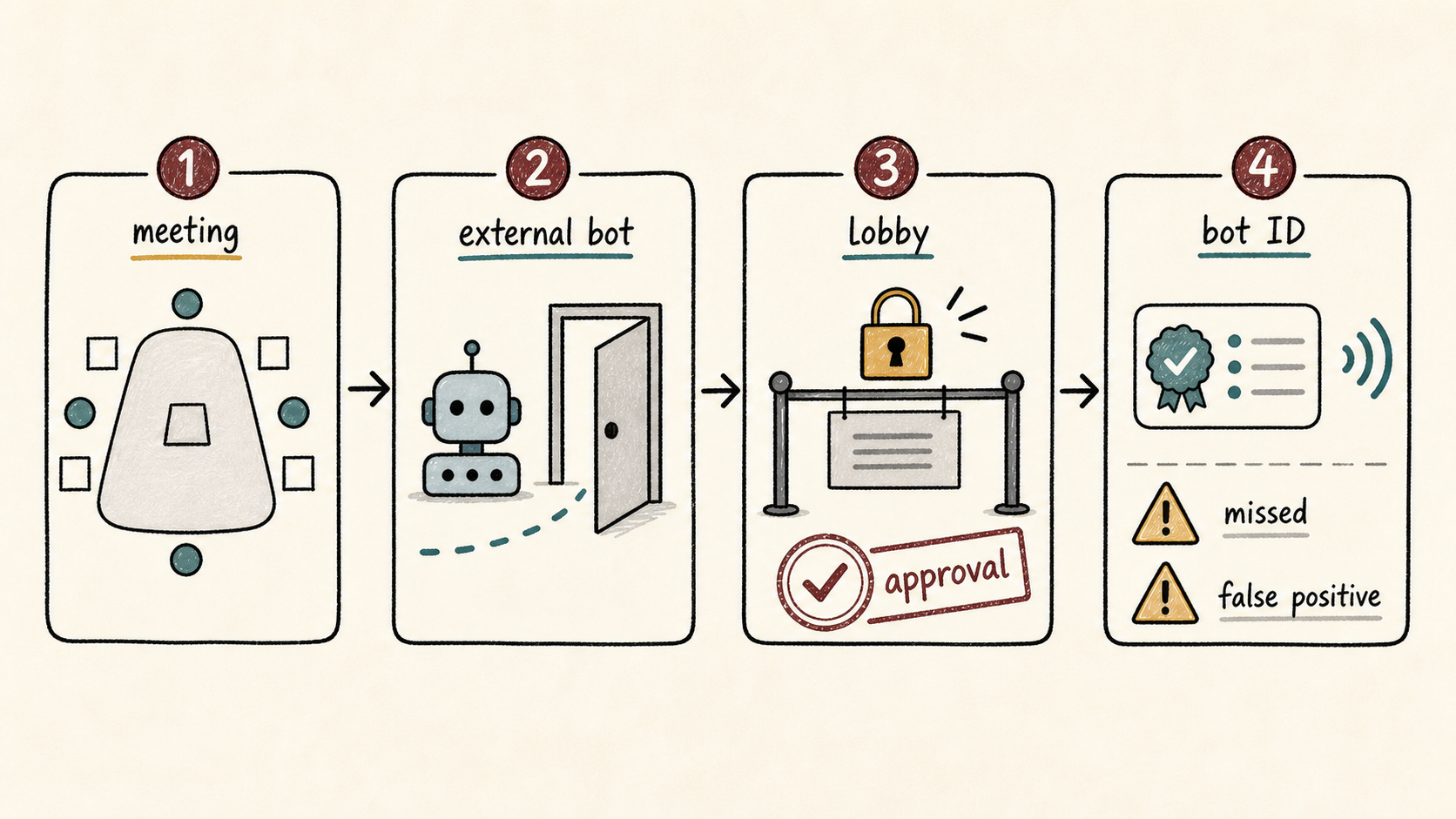
Microsoft updated Teams with controls that detect external meeting-assistant bots and place detected bots in the lobby for organizer approval. Microsoft Learn says the default policy is RequireApprovalWhenDetected, with an admin option to allow detected bots through policy instead.
Microsoft also published a Teams Bot Identification Program page for meeting-bot vendors. The Register framed the change around third-party meeting assistants that can record or transcribe calls, while Microsoft’s documentation describes vendor self-identification as a way for bots to include a marker in meeting join requests.
Featured source: The Register , Microsoft Learn , Teams Bot Identification Program .
Other Stories
Proton Launches Lumo 2.0 for Its Private AI Assistant
Proton launched Lumo 2.0, adding reasoning modes, image analysis and generation, stronger web search, memory, Projects, and custom assistants to its AI product. Proton says Lumo conversations use zero-access encryption, are not logged, are not shared with third parties, and are not used to train future models.
Filed from: TechCrunch , Proton .
Oracle Moves to Deprecate the macOS x64 JDK Port
Oracle is moving to stop maintaining the macOS/x64 port of the Java Development Kit from JDK 27, according to The Register. The OpenJDK pull request implementing the deprecation remains open and notes that the JEP was still submitted when the implementation was opened for review, with several reviewers approving the PR on June 29 and June 30.
Filed from: The Register , OpenJDK .
OKX Opens an AI-Agent Marketplace for Agent Commerce
OKX opened an AI-agent marketplace to developers after a closed beta with 50 AI service providers, according to TechCrunch. OKX’s earlier Agent Payments Protocol post describes an open standard for agent commerce, including agent-to-agent payments, metered usage, and future escrow and dispute-resolution flows.
Filed from: TechCrunch , OKX .
NVIDIA Publishes Vision AI Agent Workflows for Omniverse and Metropolis
NVIDIA published workflows for building vision AI agents with Metropolis blueprints, Omniverse and OpenUSD simulation, synthetic data, Cosmos, and TAO. The post cites Roboflow and Corning defect inspection, Linker Vision smart-city deployments, and DeepHow’s live standard-operating-procedure verification agent at Foxconn as partner examples.
Filed from: NVIDIA Blog , NVIDIA .
From the Community
Ornith-1.0 Open-Source Coding Models Released
DeepReinforce AI released Ornith-1.0, a family of open-source coding models in 9B, 31B, 35B MoE, and 397B MoE sizes, post-trained on Gemma 4 and Qwen 3.5. The project reports benchmark results on Terminal-Bench 2.1, SWE-Bench, and NL2Repo, and the models are MIT-licensed with a 256K context window and OpenAI-compatible tool calling.
Filed from: GitHub .
LinuxMD Ports Linux to the Sega MegaDrive
The LinuxMD project ported Linux to the Sega MegaDrive, using a Mega EverDrive cartridge that provides 4MB of RAM and an SD card interface to boot u-boot, a Linux kernel, and an EROFS root filesystem. Serial console access is available over USB, and a video output console with scrolling is functional, while the project says the system is slow on the 12MHz 68000 CPU.
Filed from: GitHub .
Branded Types Apply Parse-Don’t-Validate to TypeScript
A TypeScript post applies Alexis King’s parse-don’t-validate principle with branded types using unique symbols to create nominal-like type safety. The article covers structural typing limits, discriminated unions for error handling, parser-module casts, and Zod as ergonomic support for the pattern.
Filed from: Article .