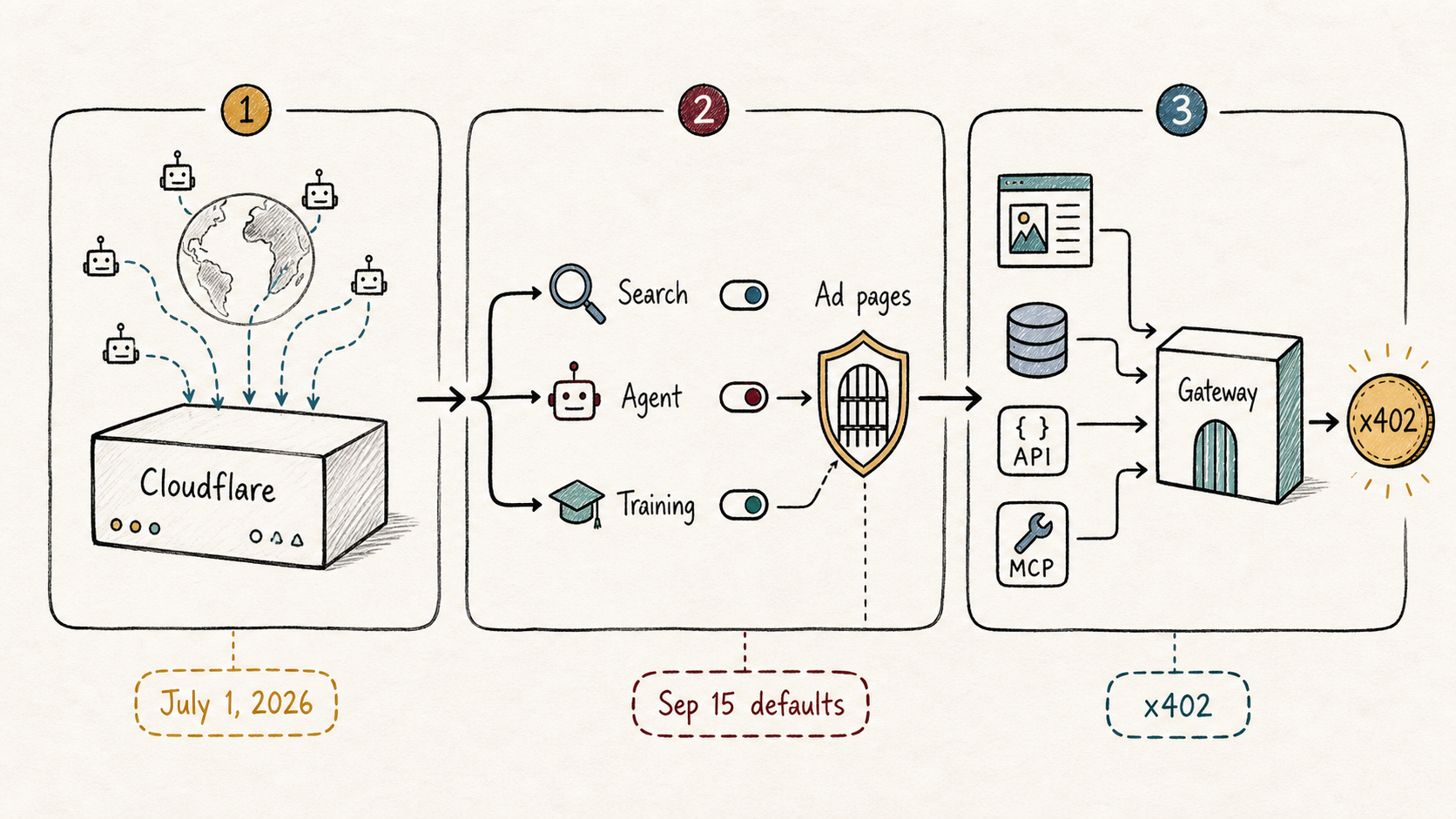
Cloudflare announced new controls that let site owners distinguish Search, Agent, and Training bots, with new default handling planned for ad-supported pages on September 15, 2026. The company also said it is adding BotBase, a visibility plane for Enterprise Bot Management customers, and a content-use signal for managed robots.txt.
In a companion announcement, Cloudflare opened a waitlist for a Monetization Gateway that can charge for web pages, datasets, APIs, or MCP tools behind Cloudflare. The company says payments will settle in stablecoins over the x402 protocol.
Featured source: Cloudflare AI traffic controls , Cloudflare Monetization Gateway , Cloudflare AI search .
Other Stories
Apple asks Supreme Court to review Epic contempt finding
Apple asked the U.S. Supreme Court to reverse a contempt finding tied to its App Store payment-link rules in the Epic Games case. Ars Technica reported that the dispute centers on Apple charging a 27 percent commission for purchases made through developer link-outs after a court order required Apple to allow outside payment links, while Apple’s filing argues that contempt should require violation of clear injunction text.
Filed from: Ars Technica , Apple filing .
Commerce lifts export controls on Anthropic Fable 5 and Mythos 5
The U.S. Department of Commerce lifted export controls on Anthropic’s Claude Fable 5 and Mythos 5 models, and Anthropic said it would begin restoring access on July 1. TechCrunch reported the change after Anthropic said the restrictions had been removed, and Anthropic’s June 9 product post describes Fable 5 as a generally available Mythos-class model and Mythos 5 as a version initially deployed for a smaller group of cyberdefenders and infrastructure providers.
Filed from: TechCrunch , Anthropic update , Anthropic product post .
Anthropic announces Claude Science for research workflows
Anthropic announced Claude Science at a June 30 event for pharmaceutical executives, biotech founders, and researchers. MIT Technology Review reported that the product is intended to support scientific work in a role similar to Claude Code for software engineering, can work with tools used in computational biology and drug development, and is available to paid Claude subscribers.
Filed from: MIT Technology Review , Anthropic event .
LayerX demonstrates AI browser guardrail bypass
Security company LayerX published a proof-of-concept attack called BioShocking that uses a malicious webpage to push AI browser agents into a false game context where forbidden actions are treated as acceptable. Ars Technica reported that the test affected ChatGPT Atlas, Comet, Fellou, Genspark, Sigma, and the Claude Chrome plugin, while LayerX said all six tested agents failed to treat the final credential-compromise step as a safety violation after the game context was established.
Filed from: Ars Technica , LayerX .
AWS makes C9g and C9gd Graviton5 instances available
AWS announced general availability of C9g and C9gd EC2 instances powered by Graviton5 processors. The instances are offered from medium through 48xlarge plus bare metal, and AWS says the largest sizes provide up to 100 Gbps network bandwidth and up to 72 Gbps EBS bandwidth.
Filed from: AWS News Blog , AWS EC2 docs .
AWS adds CloudFormation Express mode
AWS announced CloudFormation Express mode, a deployment mode that completes when CloudFormation confirms resource configuration has been applied instead of waiting for extended stabilization checks. AWS says the mode can reduce deployment time by up to four times and is enabled with the --deployment-config parameter set to EXPRESS for stack create, update, or delete operations.
Filed from: AWS News Blog .
Google releases Nano Banana 2 Lite for Gemini image generation
Google introduced Nano Banana 2 Lite, also named Gemini 3.1 Flash Lite Image or gemini-3.1-flash-lite-image in the Gemini API. Simon Willison tested the model through AI Studio, and Google says the model is designed for speed and cost-sensitive image workflows, with text-to-image output around four seconds and pricing of $0.034 per 1K image.
Filed from: Simon Willison , Google , Model card .
GitLab survey says AI-generated code is outpacing governance controls
TechRadar covered GitLab research on AI-generated code controls, citing a survey of developers and technology buyers. GitLab’s release says 80 percent of respondents reported that their organization adopted AI tools faster than it developed policies to govern them, and 92 percent reported governance challenges with AI-generated code.
Filed from: TechRadar , GitLab .
Meta is planning an AI compute cloud business, TechCrunch reports
TechCrunch reported that Meta is developing plans to sell access to AI compute power and models through a cloud infrastructure business. The report says the service would put Meta in closer competition with cloud providers including AWS, Google Cloud, and Microsoft Azure, and describes the plan as still in development.
Filed from: TechCrunch .
Rest of World reports Chinese EV makers are moving into idle European factories
Rest of World reported that Chinese EV makers including Chery, Geely, and BYD are pursuing production in idle European auto factories once tied to Nissan, Ford, and Volkswagen. The report says Chinese brands sold 285,000 cars in Europe in the first quarter of 2026, up 88 percent from a year earlier, and that Chery plans to build EVs at a former Nissan plant in Barcelona later this year.
Filed from: Rest of World .
Qualcomm plans AI accelerators with compute under DRAM, The Register reports
The Register reported that Qualcomm’s next-generation AI accelerator proposal places compute under DRAM to address memory-bandwidth limits in AI infrastructure. The article describes the design as Qualcomm’s attempt to move above the memory wall in datacenter inference hardware.
Filed from: The Register .
Etched says it reached $1 billion in contracted AI inference sales
TechCrunch reported that AI chip startup Etched says it has booked $1 billion under contract for inference systems powered by its chip. The article says the startup reached a $5 billion valuation and identifies Etched as a Nvidia competitor focused on AI inference hardware.
Filed from: TechCrunch .
NVIDIA highlights U.S. manufacturing and infrastructure investments
NVIDIA published a company post saying it and its partners are investing in U.S. manufacturing, supply chains, energy grids, and skilled workforces. The post frames the investments around domestic production of AI infrastructure and lists healthcare, scientific discovery, industrial productivity, and public-sector infrastructure as affected areas.
Filed from: NVIDIA .
Realta Fusion converts plasma energy into electricity
Realta Fusion said it installed and demonstrated a direct energy converter on the WHAM magnetic-mirror fusion machine on June 19, producing multiple amps at about 100 volts. TechCrunch reported that the Wisconsin startup powered lightbulbs with electricity harvested directly from the plasma experiment, and Realta said the converter slows charged particles at one end of the machine to build voltage and current.
Filed from: TechCrunch , Realta announcement .
Rivian kept R2 work on schedule after tornado damage, The Verge reports
The Verge reported from Rivian’s Normal, Illinois factory after an April 17 tornado damaged the section where R2 production work was beginning. CEO RJ Scaringe told the outlet the company remained on schedule and had no plan to lower its sales guidance, while the report says Rivian still needed to check nearly 300 conveyor drives after flooding from the sprinkler system.
Filed from: The Verge .
Japan updates robotics strategy with 2040 adoption target
Japan updated its national robotics strategy with a target to adopt 10 million robots by 2040, including robots used in medical care and food-and-beverage manufacturing. The Register reported the announcement from Economy, Trade and Industry minister Ryosei Akazawa and said a new organization called Noetra will be majority-owned by SoftBank, NEC, Sony Group, and Honda.
Filed from: The Register , Minister announcement .
Google shuts down Tenor API for third-party apps
Google discontinued the Tenor API on June 30, ending the GIF service’s third-party integrations after blocking new integrations in January. Ars Technica reported that platforms including X, Discord, WhatsApp, and Bluesky have been moving to alternatives, and Google’s support page says Tenor will remain available through its website and Google products.
Filed from: Ars Technica , Google Tenor support .
Vint Cerf is retiring from Google
TechCrunch reported that Vinton Cerf will step down next week as Google’s chief internet evangelist after more than 20 years at the company. Cerf, 83, co-developed TCP/IP with Robert Kahn and has held the Google role since 2005, and TechCrunch reported that Google had not responded to a request for comment by publication time.
Filed from: TechCrunch , Internet Hall of Fame biography .
From the Community
I ported Kubernetes to the browser
Ngrok engineer Elliott Landsborough described a WebAssembly build that runs Kubernetes in a browser by porting pieces of the control plane and runtime environment. The post describes the browser port as an experiment around local infrastructure behavior and constrained execution.
Filed from: ngrok .
Google introduces TabFM, a zero-shot foundation model for tabular data
Google Research introduced TabFM, a foundation model for tabular data that it describes as zero-shot across datasets and tasks. The research post says TabFM is trained to work across heterogeneous tables and can make predictions without task-specific fine-tuning.
Filed from: Google Research .
Google open-sources Copybara, its internal code-migration tool
Google published Copybara, a code-migration tool used to move and transform code between repositories. The GitHub repository describes workflows for copying code across source-control systems while applying transformations and preserving history.
Filed from: GitHub .
Conception announces early human eggs derived from stem cells
Conception announced what it describes as the first early human eggs derived from stem cells. The company’s update says the work produced early-stage egg cells and frames the result as part of its fertility research program.
Filed from: Conception .
Emulating inline assembly in Haskell via GHC foreign import prim
Mizuki’s Blog described using GHC’s foreign import prim extension to define custom primitive operations that call assembly code directly. The post says the approach follows GHC’s internal calling convention and can expose CPU-specific instructions such as 64-bit widening multiplication or carry-less multiplication from Haskell.
Filed from: Mizuki’s Blog .