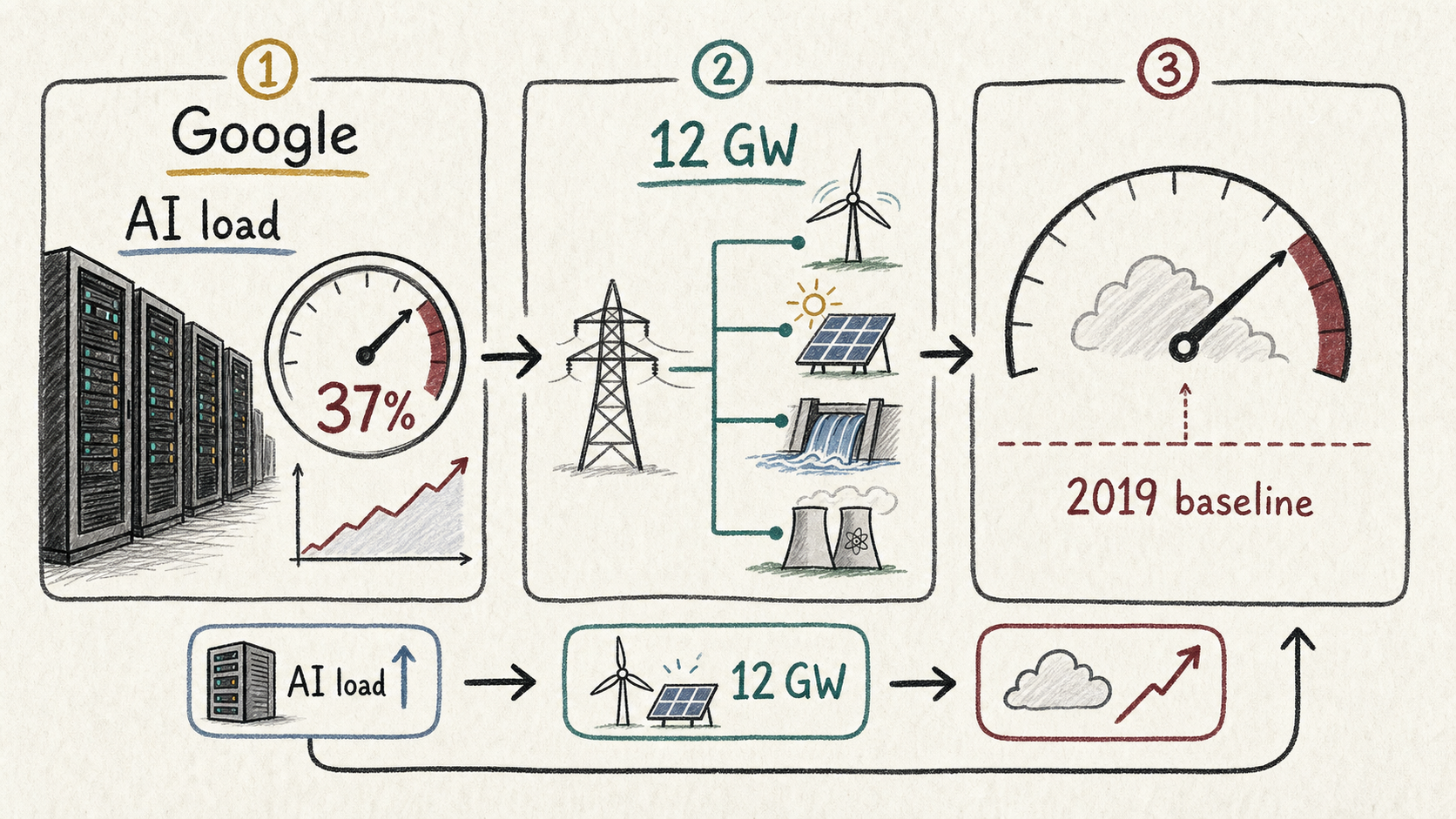
Google’s 2026 Environmental Report says the company’s electricity consumption rose 37 percent in 2025 as AI infrastructure expanded. The report says Google contracted 12 GW of clean energy during the year, including wind, solar, hydro, and nuclear power.
Ars Technica reported that Google’s emissions remain above its 2019 baseline despite the company’s clean-energy procurement. Google’s report says supplier and data-center emissions remain part of the company’s disclosed footprint.
Featured source: Ars Technica , Google report .
Other Stories
Microsoft creates Frontier company for enterprise AI deployments
Microsoft announced a new operating business called Microsoft Frontier company, focused on enterprise AI deployments using Microsoft AI tools. TechCrunch reported that the venture is backed by a $2.5 billion Microsoft commitment and 6,000 industry and engineering experts, and that Microsoft Commercial Business CEO Judson Althoff described it as broader than forward-deployed engineering.
Filed from: TechCrunch , Microsoft Frontier Firm context .
OpenAI reportedly discussed a 5 percent U.S. government stake
The Verge, citing the Financial Times, reported that OpenAI discussed giving the U.S. government a 5 percent ownership stake as part of talks around public participation in AI gains. Anadolu and The Guardian also reported the Financial Times account, and The Verge said the talks were early and any deal would likely require congressional approval.
Filed from: The Verge , Anadolu .
Cisco Talos details ARToken panel linked to EvilTokens phishing
Cisco Talos said it identified ARToken, a phishing-as-a-service operator panel that shares infrastructure, API contracts, and operational patterns with EvilTokens. Talos reported more than 80 API endpoints for device-code phishing, Primary Refresh Token persistence, email access, business-email-compromise operations, and SharePoint exfiltration.
Filed from: Cisco Talos , The Register .
Anthropic launches Claude Sonnet 5 with lower agent pricing
Anthropic released Claude Sonnet 5 as the default model for Claude Free and Pro users and made it available in Claude Code and the Claude Platform. Anthropic said it starts at $2 per million input tokens and $10 per million output tokens through August 31, then moves to $3 and $15, and said its evaluations found lower undesirable behavior than Sonnet 4.6.
Filed from: Anthropic , The Register .
UN scientific panel publishes preliminary AI governance report
The UN’s Independent International Scientific Panel on AI published a preliminary report ahead of the first Global Dialogue on AI Governance in Geneva on July 6 and 7. The panel said AI access alone does not create equal benefit and warned that countries relying on foreign models, cloud infrastructure, and data pipelines may lose practical control over standards, safeguards, and local fit.
Filed from: The Register , UN report page .
Apple Hide My Email flaw can expose real addresses
404 Media reported that a vulnerability in Apple’s Hide My Email feature can reveal the real email address behind a generated alias and said it verified the issue with one of its own hidden addresses. Apple’s support documentation describes Hide My Email as an iCloud+ feature for generating random addresses that forward to a personal account, and MacRumors reported that the researcher first disclosed the flaw to Apple in June 2025.
Filed from: 404 Media , Apple support , MacRumors .
Tesla reports 480,126 second-quarter deliveries
Tesla said it produced 451,758 vehicles and delivered 480,126 vehicles in the second quarter of 2026. The company also reported 13.5 GWh of energy-storage deployments and said it will post second-quarter financial results after market close on July 23.
Filed from: Business Wire , TechCrunch .
Oracle filing details AI infrastructure spending risks
Oracle told investors in its annual filing that growth in Oracle Cloud Infrastructure requires significant capital and operating spending for data-center capacity and new locations. The company also flagged customer non-payment, non-renewal, power availability, permitting, construction, equipment, and regulatory risks tied to that buildout.
Filed from: The Register , Oracle SEC filings .
WhatsApp username reservations draw impersonation concerns in India
WhatsApp began rolling out username reservations before a broader launch planned later this year, and TechCrunch reported that some handles resembling public figures, institutions, and brands were still available in early testing. TechCrunch said India’s IT ministry sent WhatsApp a notice warning the feature could increase fraud, phishing, digital arrest scams, and impersonation attacks.
Filed from: TechCrunch , WhatsApp .
Bending Spoons closes 40 percent above IPO price
Bending Spoons closed at $40.50 on July 1, nearly 40 percent above its $29 IPO price, giving the Milan-based software acquirer a $25.7 billion market capitalization. TechCrunch reported that the company raised $1.68 billion and cited its SEC filing for Q1 revenue of $601 million and net income of $27.4 million.
Filed from: TechCrunch , SEC filing .
U.S. energy storage installations set a Q1 record
Wood Mackenzie and the American Clean Power Association said the U.S. installed 3.3 GW and 8.4 GWh of battery energy storage in Q1 2026, beating the previous Q1 record by 54 percent. Their report said the residential segment installed a record 1.3 GWh, up 86 percent year over year.
Filed from: Wood Mackenzie , ACP report page .
Anthropic says it is removing hidden Claude Code anti-distillation markers
The Register reported that Anthropic planned to remove hidden Claude Code markers that were added in March to detect unauthorized resellers and model-distillation attempts. The report said an Anthropic engineer stated that the pull request had been merged and was expected in the July 1 Claude Code release.
Filed from: The Register , Claude Code releases .
From the Community
Oomwoo publishes an open-source robot vacuum build
Maker’s Pet published oomwoo, an open-source robot vacuum that owners build with a Raspberry Pi, 2D LiDAR, and a 3D-printed chassis. The project runs ROS 2 for mapping and navigation, integrates with Home Assistant, and provides chassis files, a bill of materials, and build instructions.
Filed from: Maker’s Pet , GitHub repo .
Google open-sources Zero-Knowledge Proof libraries for privacy-preserving age assurance
Google has open-sourced its Zero-Knowledge Proof libraries, making the cryptographic tools available to developers. The libraries enable proving attributes such as age without revealing other personal data, and Google’s post says the release supports EU eIDAS digital identity wallet requirements. The release follows Google’s partnership with Sparkasse around privacy-preserving age assurance.
Filed from: Google Blog , GitHub repo .
Kimi K2.7 Code open-weight model reaches GitHub Copilot
GitHub Copilot now offers Kimi K2.7 Code, an open-weight model, as a selectable option in the model picker. GitHub said it is the first open-weight model available in Copilot, is hosted by GitHub on Microsoft Azure, and is rolling out gradually to Copilot Pro, Pro+, and Max plans.
Filed from: GitHub Blog .
Weave Robotics launches Isaac 1 home robot
Weave Robotics announced Isaac 1, a mobile home robot designed to handle laundry and room reset tasks. The company says Isaac 1 uses custom actuators, a collapsible torso, and soft fabric shells, and is priced at $7,999 upfront or $449 per month with first shipments beginning in California in fall 2026.
Filed from: Weave Robotics .
ZCode launches a GLM-5.2 coding platform
ZCode launched a development platform optimized for GLM-5.2, with agentic coding, multi-agent collaboration, and integrations with messaging tools including WeChat, Feishu, and Telegram. The product page says the platform supports more than 20 coding tools and offers Lite, Pro, Max, and Enterprise tiers.
Filed from: ZCode .