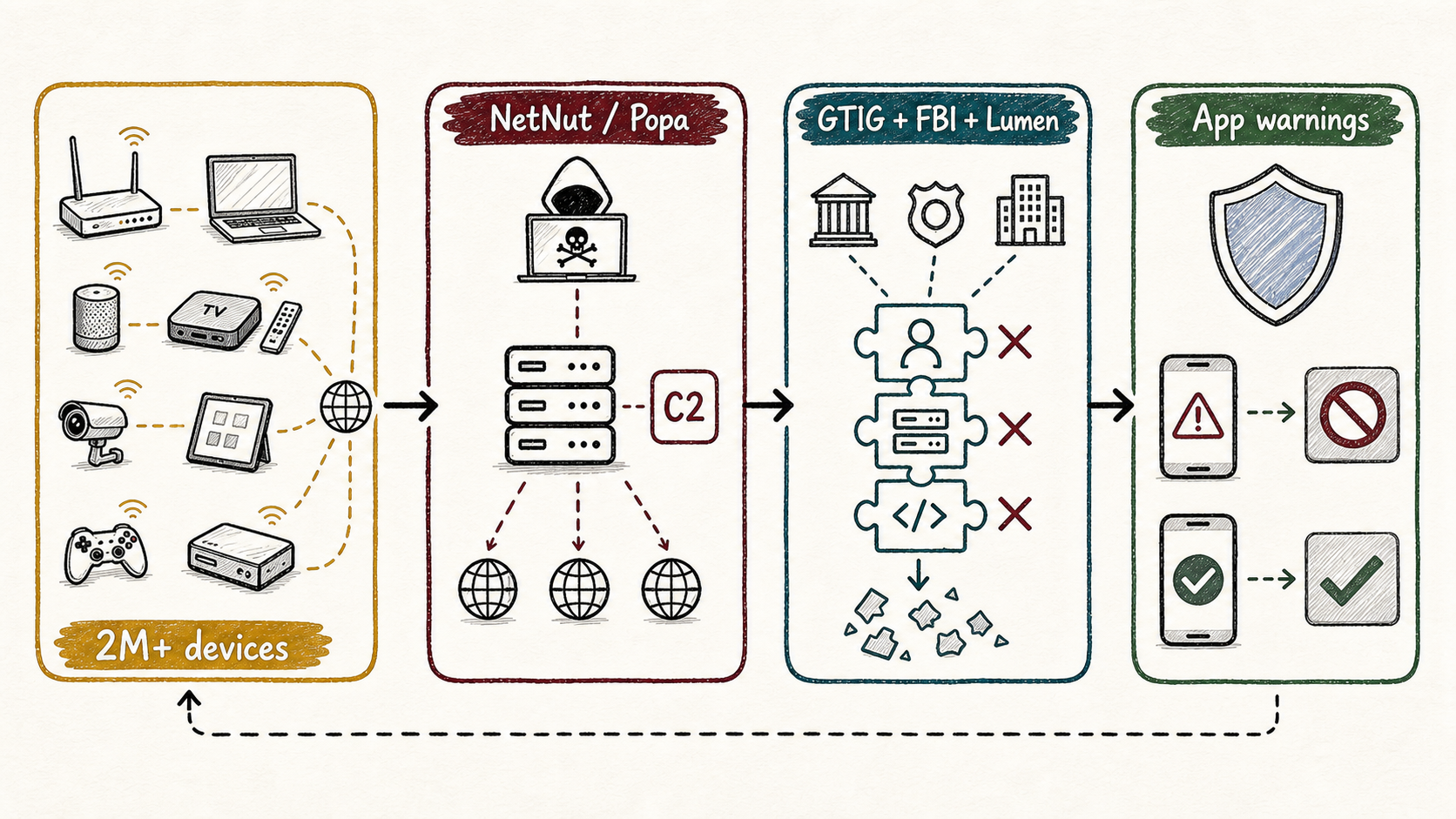
Google Threat Intelligence Group said it coordinated with the FBI, Lumen, and other partners to disrupt NetNut, also known as Popa, a residential proxy network it estimates at at least 2 million devices. Google said the operation disabled Google accounts and services used for command and control, shared technical intelligence with platform providers and law enforcement, and had Google Play Protect warn users or disable known apps containing NetNut SDKs.
The Register reported that other residential proxy brands may rely on the same network. Google’s post says its analysis found NetNut-related infrastructure using compromised systems, application SDKs, and backend services to route proxy traffic.
Featured source: The Register , Google .
Other Stories
EU court upholds Google’s Android antitrust fine
The Court of Justice of the European Union dismissed Google and Alphabet’s appeal in the Android antitrust case, leaving in place a fine of about EUR4.1 billion. The court press release says the case concerned restrictions tied to Google Search, Chrome, revenue-share agreements, and anti-fragmentation obligations for Android device makers and mobile network operators.
Filed from: Ars Technica , Court press release .
NVIDIA adds revenue sharing to AI cloud capacity deals
NVIDIA introduced a partner model for AI cloud providers that combines product revenue with a share of cloud revenue on supported capacity. The company named Sharon AI and Firmus among the first participants, saying Sharon AI is deploying up to 40,000 Grace Blackwell GB300 GPUs and Firmus is building a Batam, Indonesia DSX AI factory campus expected to scale to 360 megawatts and up to 170,000 NVIDIA GPUs.
Filed from: The Register , NVIDIA .
Citizen Lab says former PEGA committee member was hacked with Pegasus
Citizen Lab said former European Parliament member Stelios Kouloglou was infected with NSO Group’s Pegasus spyware while he served on the PEGA committee investigating spyware abuses. The lab said forensic artifacts showed successful infections around October 21, 2022, and again on March 6 and 7, 2023; TechCrunch reported that Citizen Lab did not attribute the hacking to a specific government customer.
Filed from: TechCrunch , Citizen Lab .
Anthropic opens Claude Science and reports internal drug work
Anthropic introduced Claude Science, a research workbench presented at its June 30 AI for Science event, and The Verge reported that the company also plans to develop drug candidates internally. Anthropic’s event page describes Claude being used across science with pharma, biotech, and research institutions, while STAT reported that Anthropic executives framed internal drug work as a way to test its own scientific tools on research problems.
Filed from: The Verge , Anthropic , STAT .
Jamf details PamStealer macOS infostealer
Jamf Threat Labs disclosed PamStealer, a macOS infostealer distributed as a compiled AppleScript file impersonating the Maccy clipboard manager. Jamf said the campaign uses a JXA downloader, a Rust-based second-stage Mach-O payload, local password validation through macOS Pluggable Authentication Modules, and a fake maccyapp domain listed in the indicators of compromise.
Filed from: Ars Technica , Jamf .
MeetingTV sues Palo Alto Networks and Koi Security
MeetingTV sued Koi Security, its researchers, and Palo Alto Networks, alleging that a Koi threat-intelligence report falsely tied the startup’s Zoomcorder product to Chinese corporate espionage. The Register cited the court complaint and reported that Koi’s blog was later edited to remove references to Zoomcorder; Palo Alto Networks said it was aware of the lawsuit and expected the dispute to proceed through the legal process.
Filed from: The Register , Court document .
IQM lists in the U.S. through SPAC merger
Finnish quantum-computing company IQM went public on Nasdaq through a SPAC merger at a valuation of about $1.9 billion. TechCrunch cited IQM’s prospectus warning that large-scale commercial traction for quantum computing may never occur, and reported that the transaction is expected to generate about EUR198 million after costs.
Filed from: TechCrunch , IQM investor page .
Zuckerberg reportedly says Meta AI agents are progressing slowly
TechCrunch, citing Reuters, reported that Mark Zuckerberg told staff at an internal town hall that Meta’s AI-agent work had not accelerated as executives had expected. The report said Zuckerberg tied earlier layoffs and AI group reassignments to concerns about Meta moving quickly enough, while adding that he expected improvements over the next three to six months.
Filed from: TechCrunch , Reuters via Yahoo Finance .
KPMG says AI cost visibility remains limited
KPMG’s Global AI Pulse survey said 23 percent of leaders struggle with usage-based AI costs and 42 percent have only partial visibility into AI spending. The firm said 33 percent of leaders cited difficulty understanding AI cost structures, including token pricing, while 53 percent reported using AI cost-monitoring dashboards.
Filed from: The Register , KPMG .
Tesla driver charged with manslaughter after Katy crash
Michael Butler was arrested July 1 and charged with manslaughter after a June 19 crash in Katy, Texas, in which his Tesla Model 3 went into a home and killed 76-year-old Martha Avila. ABC News reported that local authorities, NHTSA, and NTSB are investigating; Tesla’s head of AI publicly claimed the driver manually overrode self-driving by pressing the accelerator to 100 percent.
Filed from: ABC News , The Verge .
Jon Prosser responds to Apple’s iOS leak lawsuit
MacRumors reported that YouTuber Jon Prosser filed a response to Apple’s trade-secrets lawsuit over leaked iOS 26 details, denying a coordinated scheme to harm Apple while admitting he recorded a FaceTime call showing unreleased software. The report says Prosser blamed co-defendant Michael Ramacciotti for disclosing the material and requested a jury trial.
Filed from: MacRumors , The Verge .
Simon Willison releases llm-coding-agent 0.1a0
Simon Willison released llm-coding-agent 0.1a0, a Python coding agent built on his LLM framework. The release exposes file-editing, command-execution, file-listing, file-reading, and search tools, and Willison’s post links to the package, README, spec, and commit sequence from the experiment.
Filed from: Simon Willison , GitHub release .
From the Community
U.S. Commerce directive bans differential privacy and disclosure avoidance methods
A June 4 Commerce Department directive, DAO 216-26, bans differential privacy, noise infusion, and swapping in all Census Bureau and Bureau of Economic Analysis publications, restricting disclosure avoidance to coarsening and suppression. Cynthia Dwork and co-authors wrote that coarsening alone can fail to protect privacy when multiple coarsened tables are combined.
Filed from: Shtetl-Optimized , Commerce Department directive .
Virginia bans sale of geolocation data
Virginia enacted a law prohibiting the sale of geolocation data, covering precise location information from mobile devices and other sources. Hunton Andrews Kurth wrote that the law applies to transactions involving geolocation data and includes exceptions for disclosures needed to provide a requested product or service.
Filed from: Hunton .
Wordgard rich-text editor is released
Marijn Haverbeke released Wordgard, an open-source JavaScript rich-text editor library under the MIT license, providing a programming interface for customized editors with document-structure control, custom elements, and an extension system. The editor supports screen readers, keyboard-only navigation, mobile devices, bidirectional text, tables, nested lists, captioned figures, and collaborative editing with concurrent merge.
Filed from: Wordgard , Repository .
crustc translates rustc to C
A developer published crustc, a project that translates the Rust compiler into C and presents a functional rustc buildable with GCC and make. The project page says the output contains about 46 million lines of C and describes the work as a demonstration of the cilly toolchain.
Filed from: GitHub .
okTurtles publishes Short Leash AI coding method
okTurtles founder Greg Slepak described a workflow for using AI coding agents with human review, explicit permission checks, small subtasks, and commits after each accepted change. The post also recommends AI review for pull requests and disclosure of which models were used.
Filed from: okTurtles blog .