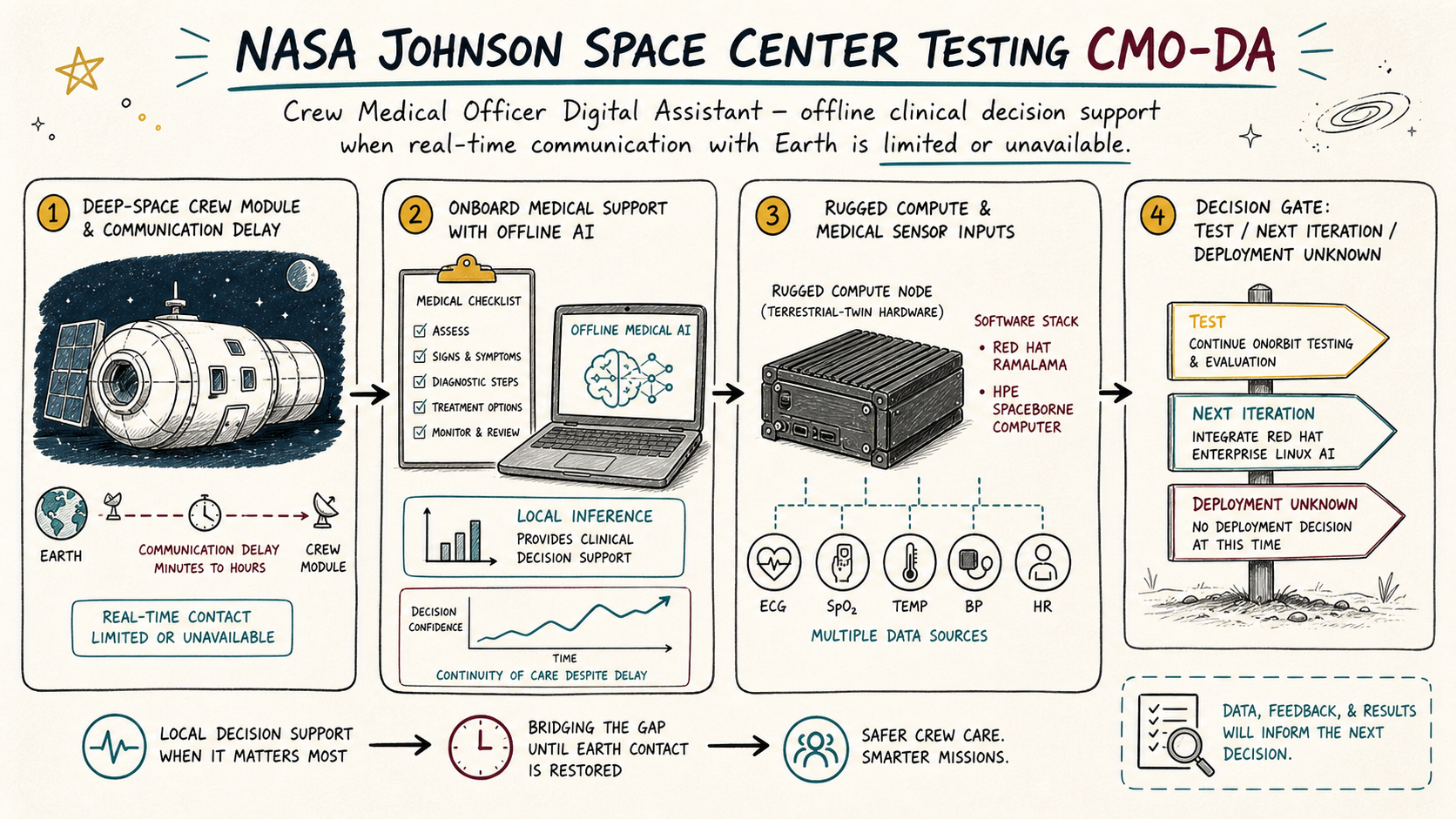
NASA Johnson Space Center is testing Crew Medical Officer Digital Assistant, a clinical decision support system for astronaut medical care when real-time communication with Earth is limited or unavailable.
Red Hat says the project uses RamaLama for local AI inference and is running on HPE hardware, specifically the terrestrial twin of the Spaceborne Computer aboard the International Space Station. Red Hat also says the next iteration is planned to integrate Red Hat Enterprise Linux AI before any further deployment decision.
Featured source: TechRadar , Red Hat .
Other Stories
Current AI publishes Open Source AI Gap Map
Current AI released v0.1 of its Open Source AI Gap Map, a public index of the open-source AI stack. Current AI says the map surveyed more than 24,626 projects and gives detailed records for 421 products: 266 software tools and libraries, 85 models, 50 datasets, and 20 hardware projects from 228 organizations.
Filed from: Simon Willison , Current AI , GitHub .
AdaptHealth discloses material cyber incident involving patient data
AdaptHealth disclosed a material cybersecurity incident in an SEC filing after a threat actor accessed cloud-based business applications, internal patient management systems, document storage platforms, and external electronic health record portals. The company said the incident came from a social engineering attack that compromised a third-party contractor user session, and that exfiltrated data included an insurance-billing password file plus some patients’ personally identifiable and protected health information.
Filed from: The Register , SEC filing .
Eye-ECMO device keeps donor eye viable for transplant research
MIT Technology Review reported on a device built to preserve donor eyes outside the body, a step toward whole-eye transplant research. The University of Miami Miller School of Medicine says its team used an eye-ECMO device to pump oxygenated blood and solution through a recovered donor eye, confirmed tissue viability, and observed retinal circulation and function.
Filed from: MIT Technology Review , University of Miami .
Teramind report says enterprise AI use is escaping account-level oversight
TechRadar reported on Teramind’s Shadow AI Behavior Report, which says 86% of organizations lack visibility into data moving to and from AI tools and 67% of enterprise AI usage runs through unmanaged personal accounts on corporate-licensed platforms. Teramind says the report draws on behavioral telemetry, a survey of 300 global enterprise CISOs, and third-party data.
Filed from: TechRadar , Teramind , Business Wire .
Active-cooled Qi2.2 chargers move into 25W wireless charging
The Verge tested Kuxiu’s D5 Qi2.2 charging dock and reported that its built-in fan kept the phone cooler than uncooled Qi chargers during use. The Wireless Power Consortium says Qi2 25W adds nearly 70% more charging power than the original Qi2 standard and can charge a compatible smartphone battery from empty to 50% in about 30 minutes.
Filed from: The Verge , Wireless Power Consortium .
PC makers define creator machines between gaming and workstation lines
TechRadar reported that Acer, Asus, and Maingear are positioning creator-focused PCs between gaming systems and workstations, with quieter industrial design, color-focused displays, GPU performance, memory, and fast storage as recurring requirements. The report says Acer used ConceptD to test the segment, Asus is continuing with ProArt PCs and monitors, and Maingear sees overlap between gaming and creator hardware.
Filed from: TechRadar .
From the Community
PEGA committee member hacked with Pegasus while investigating spyware
Citizen Lab found that former European Parliament member Stelios Kouloglou was infected with NSO Group’s Pegasus spyware on at least two occasions while serving on the PEGA committee investigating spyware abuses, with infections occurring during key periods of committee activity including preparations for a draft report and a research trip to Greece and Cyprus. The first infection is linked to a previously identified Pegasus campaign targeting exiled journalists in Europe.
Filed from: Citizen Lab .
Mistral releases Leanstral 1.5 for formal verification
Mistral AI released Leanstral 1.5, an Apache-2.0 licensed model with 119B total and 6B active parameters, achieving state-of-the-art results on formal verification benchmarks including saturating miniF2F, solving 587 of 672 PutnamBench problems, and reaching 87% on FATE-H and 34% on FATE-X. In real-world testing across 57 repositories, the model uncovered five previously unknown bugs.
Filed from: Mistral AI .
AMD MI355X delivers inference benchmarks against Blackwell
Wafer published benchmarks showing GLM-5.2 served on AMD MI355X GPUs achieves 2626 tok/s/node aggregate throughput and 213 tok/s single stream, at roughly 2.75x lower GPU cost than NVIDIA B300/B200. The test used MXFP4 quantization and sglang with speculative decode after minor ROCm fixes.
Filed from: Wafer .
SearXNG maintains an open-source metasearch engine
SearXNG is an open-source metasearch engine that aggregates results from search services and databases without tracking or profiling users. The project is self-hostable and licensed under AGPL-3.0.
Filed from: GitHub .
Study says tall tropical trees compensated during drought
Research published in Science found that Dipterocarp trees up to 71 meters tall adjust their water transport systems with wider vessels near the ground and drought-adapted leaves. The University of Exeter said the trees showed no height-related growth loss during the 2023-2024 El Nino drought.
Filed from: University of Exeter .
Steam Controller Auto-Charge uses optical flow and haptics
An open-source project uses an overhead webcam and OpenCV.js optical flow to autonomously guide a Steam Controller into a magnetic charging puck, navigating via 70 Hz asymmetric haptic pulses through its internal linear resonant actuators and halving pulse frequency within 150 pixels of the puck. WebHID telemetry streams battery status and cell voltage, while a Rust/WASM CNN handles object avoidance in the browser.
Filed from: GitHub .
Epoch AI reports CVE severity spike after Claude Mythos Preview
Epoch AI reports that high- and critical-severity CVE disclosures from 21 notable organizations reached about 1,500 in June 2026, more than 3.5x the previous monthly record, following Anthropic’s April announcement that Claude Mythos Preview could autonomously discover software vulnerabilities. Anthropic claims Project Glasswing has identified more than 10,000 high- or critical-severity vulnerabilities, many not yet publicly disclosed.
Filed from: Epoch AI .
LineageOS explains Android Developer Verification
Google’s Android Developer Verification, rolling out regionally from September 2026, requires apps to be registered to an identity-verified developer before installation on certified Android devices, regardless of installation source. LineageOS states the change does not affect its ROM because it does not ship Google Mobile Services, but warns that GApps packages could bundle the verification app.
Filed from: LineageOS .